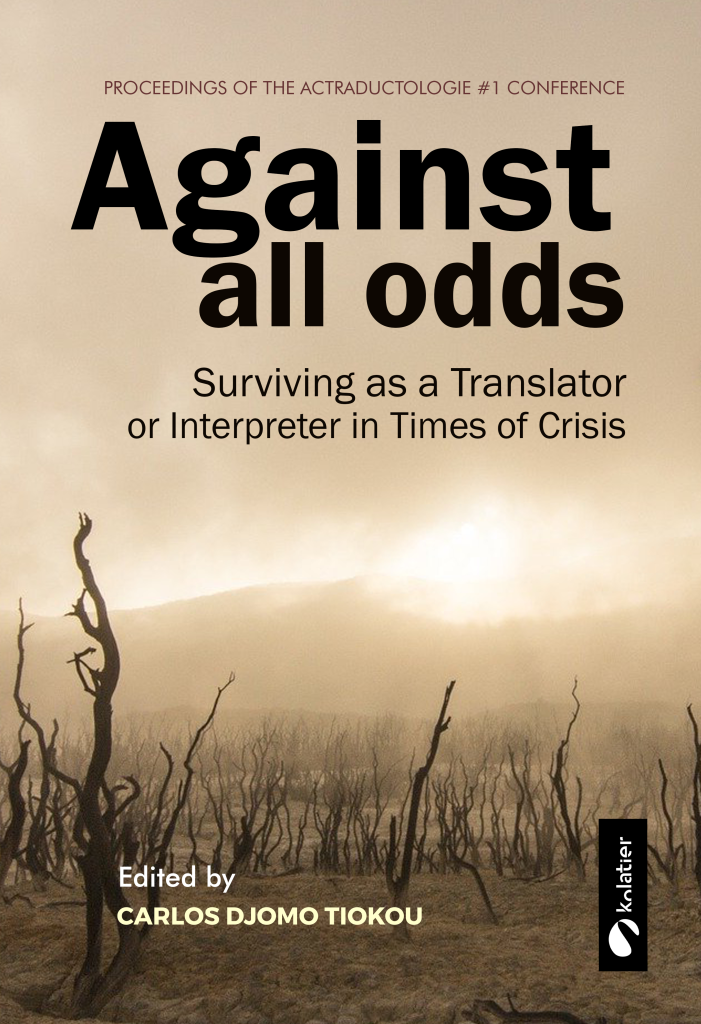
Surviving as a Translator or Interpreter in Times of Crisis
Surviving today's changes. Preparing for tomorrow's challenges.
PROCEEDINGS FROM THE ACTRADUCTOLOGIE #1 CONFERENCE
Edited by Carlos DJOMO TIOKOU (ESIT/Sorbonne Nouvelle University)
Surviving as a translator or interpreter. What a tough question to deal with. Especially as language professions have been subject to numerous threats, nurtured by frequent misconceptions, lack of harmonised regulation, and AI-driven “replacement” narratives. Twelve scholars with varied backgrounds attempt to tackle translator survival from different yet complementary perspectives, based on their contributions at the 1st ACTRAductologie International Conference.
TABLE OF CONTENTS
Introduction: Translation as Resilience Carlos DJOMO TIOKOU ESIT/Sorbonne Nouvelle University
PART 1 – TRANSLATION AND ARTIFICIAL INTELLIGENCE
Exploring the Potential of ChatGPT to Translate Idioms in Chinese Political Speeches Yvan Rudhel MEGAPTCHE Hubei University of Automotive Technology
Intelligences humaine et artificielle en traduction : rivalité ou complémentarité ? Moïse ATEBA NGOA ASTI/University of Buea
A Benjaminian Perspective to Translation Theory in the Age of Artificial Intelligence El-Shaddai DEVA University of Maroua
PART 2 – INTERPRETING IN CRISIS CONTEXTS
Les défis de l’interprétation en zones de conflit en Afrique : le cas du Niger Laurent R. AZAMBOU NDONGMO & Ibrahim SALEY BAARE ASTI/University of Buea
A Case for Community Interpreting in Cameroon Sebastien GANDU ASTI/University of Buea
PART 3 – TRANSLATION THEORY, POLICY, AND PEDAGOGY
La traduction : onomasiologie et rédactologie Georges L. BASTIN Université de Montréal
Students’ Views of Translator e-Training at ASTI During the Covid-19 Pandemic Viny DJONGOUE & Suzanne AYONGHE LUM ASTI/University of Buea
Translation and Language Policies in multilingual Contexts: The Case of Cameroon Stéphanie Sophie MABA KENGNE Shanghai International Studies University
A Contrastive Analysis of Verb Tense Equivalence in English and French Translations of Une si longue lettre Rissikatou M. BABALOLA Université d’Abomey-Calavi
Today, more than ever, the survival of translators and interpreters is a topic that can no longer be avoided. It is even more relevant the idea of language professionals being replaced by machines (what external stakeholders have long predicted, hoped for, or fantasized about) is close to becoming a reality
From July 11 to 13 2024, the Cameroon Association for Translation Studies (CATRAS) in partnership with the Advanced School of Translators and Interpreters (ASTI), hosted ACTRAductologie 1, an international conference which allowed fruitful exchanges, insightful communications, and thought-provoking sessions on how to best survive the changing global translation and interpreting landscape:
+ How do professionals thrive in an AI-driven era? + How does training adapt to fit market needs? + What implications for core theories?
This book is a collection of hand-picked proposals that tackle the main aspects of translator and interpreters’ survival, namely:
+ Translation and AI + Interpreters in crisis areas + Contemporary training challenges + Redefining the theory-practice dichotomy + Language/translation policy in specific contexts
How cite this book: DJOMO TIOKOU, C. (Ed.) (2025). Against All Odds. Surving as a Translator or Interpreter in Times of Crisis. Kolatier Books, ISBN: 9782960325218, 228p.
The book is structured into three main parts with relevant chapters covering sub-themes.
Part 1
Translation and Artificial Intelligence
This part explores the particular, love-and-hate, or worrisome relationship between translation and artificial intelligence (AI). As such, it examines the impact of AI tools on translation theory, processes, and methodologies.
Part 2
Interpreting in Crisis Contexts
This part deals with interpreting in crisis and overall challenging contexts. As such, contributions herein contained shed light on interpreters’ current working conditions, main challenges, as well as realistic prospects in an AI-driven era.
Part 3
Translation Theory, Policy, and Pedagogy
This part deals with translation theory, policy, and pedagogy. It addresses theoretical topics, regulatory frameworks, and purely language-related challenges both in translation schools and professional circles.
About the Editor
Carlos DJOMO TIOKOU is a translation practitioner, trainer, and researcher, who holds a PhD in Translation Studies from ESIT/Sorbonne Nouvelle University in Paris, France. He has been investigating principles, methods, and resources that can help translators become (better) entrepreneurs, thereby transitioning from mere content mediators into business owners with added-value and a tangible impact. As such, his research interests include digital media, translation technology, and innovative approaches to develop one-person translation businesses.
Spread the word
Know a colleague, student, or scholar who may be interested in this publication?